
What Is ROI in Home Loan and Why Every Buyer Should Track It

Loan in
60 Minutes
Introduction
Buying a home is one of the biggest financial decisions most people make. It involves careful planning, budgeting, and understanding how your money works over time. One key concept that can help you understand the this concept is the ROI in home loan. Knowing this can show whether your property is a growing asset or a cost that outweighs its benefits. It also helps you make smarter decisions, from choosing the right loan to planning repayments.
The Confusing Double Life of ROI in Home Loans
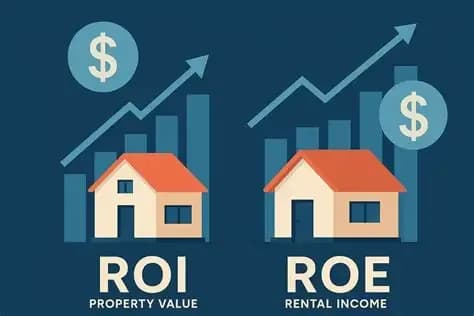
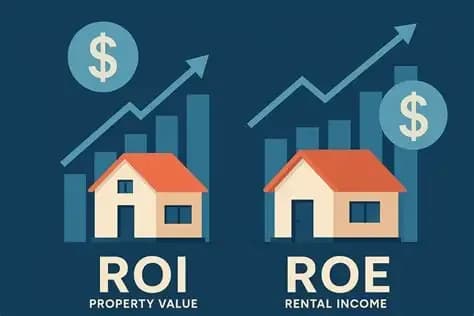
When people hear the term ROI in a home loan, it can mean two completely different things. Banks usually use ROI to mean Rate of Interest, while investors use it to mean Return on Investment.
For financial advisors, ROI means whether the property actually makes money after costs like loan interest, maintenance, and registration.
So, an 8.5% home loan ROI usually means the interest you pay the bank, not the profit the property earns for you
Two Ways to Calculate ROI in Home Loan
Method 1: Cost Approach
This method checks whether the property’s current value is higher than the total money spent on it.
The total cost includes the property price, stamp duty, registration, interiors, and home loan interest paid so far.
Example: Tanya a working professional bought a flat for ₹55 lakhs with a ₹44 lakh home loan at 8.6%. Over time, after adding interest, stamp duty, registration, and interiors, her total spending reached around ₹87 lakhs. But the property’s current value is only ₹78 lakhs. So, at the moment, the investment is still at a loss.
Method 2: Out-of-Pocket Approach
This method looks only at the money Tanya paid from her own pocket, not the bank loan.
It includes the down payment, around ₹31 lakhs in EMIs, stamp duty, registration, and interiors. The ₹44 lakh loan amount is not counted because the bank funded it.
Since most of the property was bought using borrowed money, the ROI appears higher. Using an EMI calculator to estimate these cumulative outflows before signing any agreement helps buyers avoid underestimating the true cost.
What Pushes Home Loan ROI Up or Down
Fixed vs Floating Rates
On a long home loan, even a small difference in the rate of interest can change the total repayment by several lakhs. For example, a 9.5% fixed rate on a ₹45 lakh loan costs much more over time than a floating rate averaging 8.75%.
But floating rates can increase when RBI raises repo rates. Between 2022 and 2023, many borrowers saw their EMIs rise by around ₹2,000 to ₹4,000 per month. Borrowers with fixed interest rates were not affected by these hikes.
Tenure
On a ₹50 lakh loan at 9%, total interest at 15 years is approximately ₹36.8 lakhs. At 25 years, it climbs to ₹68 lakhs. The monthly EMI drops by ₹8,000 to ₹9,000, which feels comfortable, but that comfort costs ₹31 lakhs over the loan's life. Finnable's home loan prepayment calculator shows how one extra payment per year can cut tenure by 3 to 5 years and save significant interest.
Location
Areas near new metro lines and IT parks in Bengaluru or Hyderabad have seen 9% to 14% annual appreciation over the past five years. Parts of Greater Noida show the opposite: a ₹42 lakh apartment from 2015 now fetches ₹35 to ₹38 lakhs. Same asset class, vastly different outcomes. Checking the minimum salary for a home loan also helps set a realistic purchase budget before committing to a location.
Credit Score
Two borrowers, same flat, same income. One with a CIBIL score of 790 gets 8.5%. The other at 670 is offered 9.35%. On ₹40 lakhs over 20 years, that 0.85% gap adds roughly ₹8.4 lakhs to the total bill. Spending 6 months clearing old dues and keeping credit card utilisation below 30% before applying is one of the lowest-cost ways to improve property returns. The minimum CIBIL score required for a home loan varies by lender, so checking early sets realistic expectations.
Knowing What Is ROI in Home Loan: Three Practical Reasons
The rent-vs-buy calculation is the first reason. A Bengaluru buyer paying ₹52,000 EMI plus ₹4,000 maintenance could rent an equivalent flat for ₹22,000. The property needs 6% or more annual appreciation for buying to beat renting. Many micro-markets do not reach that threshold. Running the RoI in home loan number before purchasing surfaces this gap early.
Comparing properties without guesswork is the second reason. A ₹72 lakh Indiranagar apartment appreciating 8% annually generates better returns than a ₹48 lakh Electronic City flat at 2.5%. The cheaper option feels safer. The numbers say otherwise.
Knowing when to act is the third reason. Three years of flat or declining roi in home loan numbers is a signal to consider refinancing, aggressive prepayment, or selling. Borrowers evaluating options should also understand how home loans compare with personal loans, especially if renovation funding could improve the property's market value.
Specific Strategies That Actually Boost Returns
Negotiating the interest rate directly at the bank can help reduce borrowing costs. Even a small cut of 0.10% to 0.25% can save lakhs over a long loan tenure.
Making regular prepayments also helps. Paying an extra ₹1 lakh yearly toward the loan principal can reduce both the tenure and total interest significantly.
Tax benefits improve returns too. Under Section 80C and Section 24(b), borrowers can claim deductions on principal and interest payments. For someone in the 30% tax bracket, yearly savings can go up to ₹60,000.
Balance transfers work when rates have dropped 0.5% or more. The processing fee (0.5% to 1% of outstanding) is recovered quickly when the remaining tenure is 10 or more years. Checking home loan eligibility before applying for a transfer prevents wasted enquiries.
ROI in Home Loan: Myths That Cost Buyers Money
The myth that property always appreciates has hurt buyers in Noida Extension and Dwarka Expressway who purchased between 2013 and 2015 at ₹4,500 per sq ft. Many of those properties resell today at ₹3,800 per sq ft. Tracking the roi meaning in home loan annually catches this kind of sustained decline before it becomes a ₹15 lakh surprise at resale.
The myth that lower EMI equals a better deal is equally misleading. On a ₹50 lakh loan, choosing a 25-year tenure over 15 years reduces the monthly payment by ₹8,000 but adds ₹31 lakhs in total interest. The monthly comfort is real; the cumulative cost is also real.
The myth that only investors need ROI ignores the fact that, according to a 2024 CREDAI report, 38% of metro-city home loan borrowers sell within 10 years due to career transfers, growing families, or financial pressures. Borrowers who never tracked roi in home loan enter resale negotiations without a clear floor, often accepting ₹5 to ₹8 lakhs less than they should.
The myth that tax deductions automatically make home loans profitable is perhaps the most dangerous. The Section 24(b) deduction saves ₹60,000 per year in the 30% bracket. That is meaningful cushioning on a loan where effective borrowing cost is 7.5% and the property only appreciates 3% annually. The deduction reduces the loss; it does not convert it to profit.
|
Common Myth |
Reality |
|
Property prices always go up |
Some properties bought at ₹4,500 per sq ft later dropped to around ₹3,800 per sq ft. Property values can fall too. |
|
Lower EMI means a better loan |
A longer loan tenure reduces EMI, but increases total interest paid by several lakhs over time. |
|
Only investors should track ROI |
Many homeowners sell within 10 years due to job changes or family needs. Tracking ROI helps avoid selling at a loss. |
|
Tax benefits make every home loan profitable |
Tax deductions reduce the cost, but they do not guarantee profit if property prices grow slowly. |
Putting the ROI Lens on Every Property Decision
What is roi in home loan? It is a question that deserves a concrete, data-driven answer from every buyer, not vague reassurances from a builder's sales team. A salaried professional paying ₹40,000 to ₹60,000 monthly in EMIs for 15 to 20 years has the right to know where that money goes. Feed the numbers into the formula once a year: property market value, total interest paid, stamp duty, tax deductions, maintenance costs. Compare the home loan roi against a fixed deposit return. Adjust the prepayment schedule accordingly.
Finnable offers personal loans from ₹50,000 to ₹10 lakhs with disbursal in as fast as 60 minutes through a fully digital process, useful for renovation spending that can improve property resale value. That is how property ownership becomes a real, trackable investment rather than a long series of EMIs with an uncertain conclusion.
About the Author

The answer depends on context. A bank officer means rate of interest, the 8.5% or 9.25% annual charge on the borrowed amount. A property analyst means Return on Investment: whether the flat generated profit after all costs including purchase price, stamp duty, total loan interest, interiors, and maintenance. Most borrowers only encounter the banking definition. The investment definition is what determines whether the purchase was genuinely worthwhile.
Add up everything spent: purchase price, stamp duty (5% to 7%), registration (approximately 1%), interiors, and all loan interest paid to date. Check the current market value. Formula: [(Market Value minus Total Cost) divided by Total Cost] x 100. Using the example from this article, Priya's Hinjewadi flat came out at negative 10.5%, which gave her time to adjust her prepayment strategy in year seven rather than discovering the loss at resale.
A fixed rate locks in one percentage for the entire tenure: if the rate is 9%, it stays 9% in month one and month 240. A floating rate is pegged to the RBI repo rate. In 2021 it sat around 8.25%. By early 2023, after a 250 basis point hike cycle, it had crossed 9%. Long-term data indicates floating rates typically end up cheaper over 15 to 20 years, but the 2022 to 2023 cycle imposed ₹2,000 to ₹4,000 monthly EMI increases that many borrowers had not budgeted for.
Significantly. An extra ₹1 lakh per year toward the principal on a ₹50 lakh loan at 9% saves ₹12 to ₹13 lakhs in total interest and cuts tenure by 4 to 5 years. The home loan roi climbs proportionally. Starting prepayments in the first five years matters most because the interest portion of each EMI is heaviest during that phase.
It can and it does. Buyers in Noida Extension or along Dwarka Expressway who purchased in 2014 to 2015 have paid EMIs for nearly a decade while property values stayed flat or fell. Total costs easily exceed current market value for many of those properties. The best defence is understanding the roi meaning in home loan before signing, not five years after.
Introduction
The Confusing Double Life of ROI in Home Loans
Two Ways to Calculate ROI in Home Loan
What Pushes Home Loan ROI Up or Down
Knowing What Is ROI in Home Loan: Three Practical Reasons
Specific Strategies That Actually Boost Returns
ROI in Home Loan: Myths That Cost Buyers Money
Putting the ROI Lens on Every Property Decision