
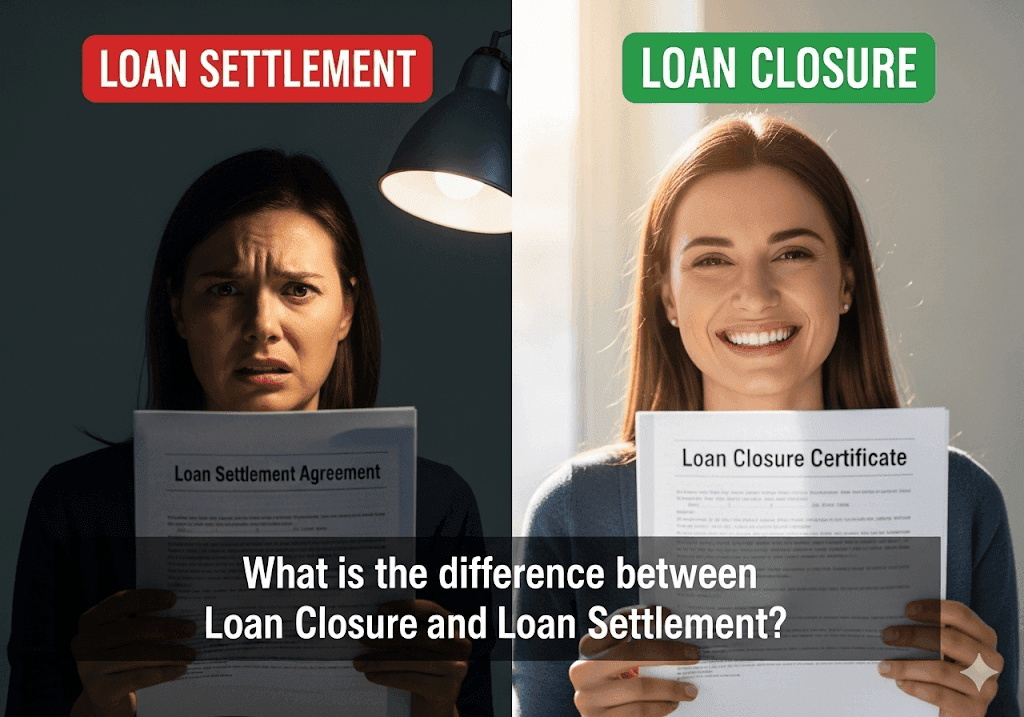
Loan Settlement vs Loan Closure: What Every Borrower Should Know


Loan in
60 Minutes
Introduction
When it comes to repaying a loan, two terms often come up: loan settlement and loan closure. While they might sound similar, they have very different meanings and impacts on your financial future. Loan settlement happens when a lender agrees to accept a reduced amount, while loan closure means that you've paid off the full loan. Knowing the difference between loan settlement vs loan closure, how each affects your credit score, and what it means for your future borrowing options can help manage your finances and make informed decisions about your loan repayments.
What is Loan Settlement and When Does it Apply?
What is loan settlement? A borrower who cannot pay back the full amount owed negotiates a reduced payout with the lender. Pay ₹2.1 lakhs instead of ₹3.5 lakhs, for example. The lender takes the hit on the balance and the account gets stamped Settled. Finnable's guide on personal loan settlement in India walks through the entire process, from initial negotiation to final documentation.
That negotiation typically only happens after 90 to 180 days of missed EMIs. By then, the borrower's credit report already shows months of defaults. Settlement adds another layer of damage. The settled tag sticks around for 7 years on the CIBIL report, and it tells every future lender one thing: this person did not honour the full obligation. Settlement amounts usually fall between 40% and 70% of the outstanding balance, depending on how much leverage the borrower has and how tired the lender is of chasing payments.
One thing barely anyone talks about: tax. Under Section 28(iv) of the Income Tax Act, the waived portion might count as income. If ₹1.2 lakhs gets written off during settlement, the borrower could owe tax on that amount. Not guaranteed in every case, but checking with a CA before signing anything is a genuinely smart move.
What Is Loan Closure and How Does It Build Credit?
What is loan closure? The borrower paid everything: every rupee of principal, every rupee of interest, and every applicable fee. Nothing left outstanding. The lender marks the account Closed on the credit report.
Two routes lead here. Route one: all EMIs paid on schedule until the very last one debits. Route two: the borrower pays off the remaining balance early (pre-closure or foreclosure). Both produce the same clean Closed status.
Pre-closure has a cost. Finnable charges 3% to 6% of outstanding principal plus 18% GST, and only after 6 EMIs have been paid. On a ₹2 lakh remaining balance, that is ₹6,000 to ₹12,000 plus tax. Not pocket change, but far cheaper than what a settled tag costs in terms of lost borrowing power over 7 years.
After the account closes, collect three documents without fail: the loan closure letter, the NOC, and for secured loans, the lien release paperwork. Skipping any of these creates headaches when applying for the next loan.
Loan Settlement vs Loan Closure: A Side-by-Side Comparison
Numbers and specifics make this loan settlement vs loan closure comparison clear:
|
What Changes |
Settlement |
Closure |
|
Amount Paid |
40% to 70% of outstanding |
100% |
|
CIBIL Report Tag |
"Settled" (red flag) |
"Closed" (green signal) |
|
Score Impact |
Drops 75 to 100 points |
Stable or improves over time |
|
How Long It Shows |
7 years from settlement date |
Positive record stays indefinitely |
|
Next Loan Approval |
Much harder for 3 to 5 years |
No negative effect |
|
What Lenders Think |
Partial default. Risky borrower. |
Responsible. Reliable. |
|
Triggered By |
90 to 180 days of default |
Full repayment or early payoff |
|
Documents Issued |
Settlement letter only |
Closure letter, NOC, lien release |
That documentation column matters. A closure letter and NOC prove the borrower owes nothing. A settlement letter confirms the lender accepted less than owed. Every credit analyst reads between those lines.
How Settlement and Closure Reshape Your CIBIL Score
About 35% of a CIBIL score rests on repayment history, just that one factor. So when an account flips to settled instead of closed, the damage ripples through the entire score calculation.
A real scenario: a borrower at 720 CIBIL settles a ₹4 lakh personal loan. Score drops to roughly 635. At 635, most banks will not even process a home loan application. Some NBFCs might, but at interest rates 4% to 6% higher than what a 750-plus borrower gets offered. On a ₹30 lakh home loan over 20 years, that rate difference means paying ₹8 to ₹12 lakhs more in total interest. All because of a settled tag.
Closure does the opposite. Consistent on-time EMI payments build a strong repayment record month after month. When that final Closed status hits the report, it caps off a positive trend that keeps the score stable or nudges it higher.
One uncomfortable truth: some lenders track settlement history internally even after the 7-year window expires. The CIBIL report may be clean, but the lender's own records might not be. For anyone wanting to understand score benchmarks, this guide on CIBIL score for personal loan spells out what different ranges mean for approval odds.
Choosing Between Settlement and Closure
Pick closure. Almost always.
Full repayment protects borrowing power for years. If the EMI feels too heavy, restructuring options exist. Ask the lender for a longer tenure (dropping a ₹8,500 EMI to ₹5,200 by extending from 3 years to 5, for example). Request a 3 to 6-month moratorium during documented hardship. Make part-payments whenever surplus funds show up to chip away at the principal.
Another option worth considering: a consolidation loan. Finnable offers personal loans from ₹50,000 to ₹10 lakhs, with disbursal as fast as 60 minutes, for eligible profiles, through a fully digital process. It evaluates borrowers based on income stability, employer reputation, and banking behaviour, not just the CIBIL number. For someone struggling with multiple EMIs, consolidating into a single loan at a manageable rate can prevent the settlement trap entirely.
Settlement makes sense only in genuinely desperate situations: prolonged job loss, serious medical crisis, or debt levels that no restructuring can fix. Even then, negotiate hard, get the lowest possible figure, and get every single term in writing. Verbal promises from recovery agents carry zero legal weight.
Impact on Different Loan Types
Not all settlements carry equal damage.
Personal loans hit hardest. No collateral backs them, so a settled personal loan signals high risk to future lenders. Approvals dry up for 3 to 5 years, minimum. Pre-closure is the far better option here, even factoring in the 3% to 6% penalty.
Home loans are different. The property acts as security, and lenders would rather repossess than accept a settlement discount. Home loan settlement is rare. When it does happen, the credit impact is severe given the loan size (₹25 lakhs to ₹1 crore is typical). The good news: RBI mandates zero pre-closure charges on floating-rate home loans for individuals. Clean closure is actually cheaper here than on personal loans.
Gold loans: settlement barely exists in this space. The lender holds physical gold. Default just means auction. Closure is straightforward: pay principal plus interest, collect the jewellery back.
Vehicle loans sit in between. Cars depreciate (a 3-year-old car might fetch 45% to 55% of its purchase price), so the collateral does not fully cover outstanding balances after extended default. Lenders sometimes accept settlement on auto loans, but it hurts the credit profile almost as much as a personal loan settlement.
Credit card one-time settlements are more common than most people realize. Banks often offer them proactively after 6-plus months of default, and the CIBIL damage mirrors personal loan settlements exactly.
Post-Settlement: Rebuilding Credit Over 12 to 18 Months
Already settled a loan? The path back is not quick, but it exists.
First step: pull the CIBIL report and verify accuracy. Errors creep in: wrong amounts, missing updates, dates that do not match. Dispute anything incorrect through CIBIL's online portal.
Then, discipline. Pay every existing obligation on time: credit cards, utility bills linked to credit, remaining loans. No exceptions for 12 to 18 months. Keep credit utilisation under 30% (if total limits are ₹3 lakhs, balances should stay below ₹90,000). Do not apply for multiple credit products in a short window because each application triggers a hard inquiry.
The single most effective move: convert settled to closed. Contact the original lender. Pay the difference between what was settled and what was originally owed. The lender updates the credit bureau, and the tag changes. This takes 30 to 45 days to reflect, and the score typically improves by 30 to 50 points over the following months. The loan closure process page details every documentation step involved.
About the Author

Not exactly. The lender accepted a reduced amount, typically 40% to 70% of outstanding dues, and wrote off the rest. The account gets a settled tag on the credit report instead of closed. That distinction matters because it signals incomplete repayment and stays visible for 7 years.
Yes. The borrower pays the original lender the gap between what was settled and what was originally owed. Once the lender receives full recovery, they request CIBIL to update the status. The change shows up within 30 to 60 days. Not every lender makes this easy, so a formal written request and follow-up help.
Seven years from the date of settlement. During that window, approval rates for new loans and credit cards drop significantly. Some lenders reject applications outright when they see settled on the report.
Pre-closure is one form of closure. It means paying off the full remaining balance before tenure ends. Regular closure happens when the last scheduled EMI debits. Both produce a positive closed status. Pre-closure typically involves a penalty with lenders charging up to 6%, plus 18% GST, after payment of 6 EMIs.
Finnable uses a holistic evaluation model. Income stability, employer reputation, banking behaviour, and repayment capacity all factor in alongside the CIBIL score. A settled status does make things harder, but its approach offers a fairer assessment compared to other lenders that reject applicants based on credit bureau data alone.
Introduction
What is Loan Settlement and When Does it Apply?
What Is Loan Closure and How Does It Build Credit?
Loan Settlement vs Loan Closure: A Side-by-Side Comparison
How Settlement and Closure Reshape Your CIBIL Score
Choosing Between Settlement and Closure
Impact on Different Loan Types
Post-Settlement: Rebuilding Credit Over 12 to 18 Months