
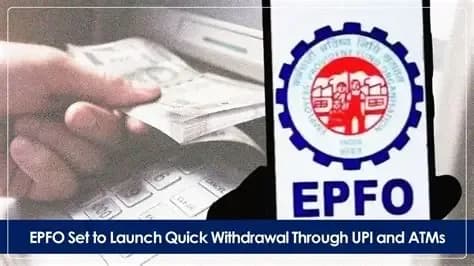
EPFO ATM Withdrawal: Process, Limits, and What Salaried Employees Should Know

Loan in
60 Minutes
The new upgrade with the EPFO allows employees to withdraw a part of their Provident Fund (PF) balance directly from an ATM. This is done using a dedicated PF withdrawal card. This updated process should be quicker than the previous 10 to 20 working days. All you need is your UAN number, Aadhaar card, PAN card, and bank details to be linked and verified in advance.
Quick Reads
-
The new EPFO updates have not completely finished rolling out. However, a few updates, such as the auto-settlement limit, are complete.
-
The EPFO ATM withdrawal limit is said to be limited to 50 to 75% of your eligible PF.
-
25% of your total PF balance needs to stay as it is.
-
The auto-settlement limit on the portal has been raised from ₹1 lakh to ₹5 lakhs.
-
For verification, your PAN card, Aadhaar card, active bank account, and mobile number are required.
Provident Fund (PF) is a savings account that is added during your working years. It's mainly used for retirement. A portion of your salary is debited into the account every month, and your employer matches that amount. EPFO, which is the government body that runs this system, manages that money under your Universal Account Number (UAN).
Withdrawing money from that account is usually a long process. You previously had to fill out a form, get your employer to sign it, and then wait. The new update with EPFO 3.0 fixes this. It allows you to withdraw PF through an ATM. This is a phased rollout, and some of these new features are still not complete. This blog looks at what is confirmed, what is still pending, and how to get your account ready either way.
What is EPFO 3.0?
EPFO 3.0 is a digital upgrade to how you access your PF. As it is rolled out in phases, there are three main changes that are expected:
-
A dedicated PF debit card for EPFO ATM withdrawals, which is subject to limits.
-
A UPI-based withdrawal option through the EPFO portal or UMANG app.
-
You can contribute more than just the mandatory minimum to your pension.
Currently, the main way to withdraw your PF online is through the portal. This process requires Form 31 for advances, Form 19 for full settlement, or Form 10C for pension withdrawal. Most of these also need Aadhaar OTP verification and employer approval.
EPFO 3.0 is aimed at making this process more efficient. Once it is fully enabled for your account, you will be able to use the EPFO-issued debit card at an authorized ATM or withdraw via UPI.
Who is Eligible for EPFO ATM Withdrawal?
Anyone with an active UAN, linked Aadhaar, and completed KYC is expected to qualify. Your PAN, bank account, and mobile number need to be verified and linked to your UAN before EPFO can issue you a PF debit card. These are some eligibility requirements:
Your UAN Must Be Active and Linked
Your UAN is a 12-digit number that is the starting point for every digital withdrawal option. This includes the ATM route. Your UAN needs to be active on the EPFO member portal, and your Aadhaar and mobile number should be linked to it as well.
You also need to remember that the name on your Aadhaar matches your bank account name. If you spot this issue in your account, then make sure to fix it on the UAN portal before the ATM facility is enabled for your account.
Documents Needed
Before EPFO issues a card, there are four main documents that are needed for verification:
|
Document |
Requirement |
|
Aadhaar |
Linked to UAN and OTP-verified |
|
PAN card |
Seeded to UAN |
|
Bank account |
Active, in your name only, correct IFSC code |
|
Mobile number |
Active and linked to UAN for OTP delivery |
Make sure that your linked mobile number is active, since every step of the process, from ATM to UPI to portal, depends on OTP delivery to that number.
How Will the EPFO ATM Withdrawal Work?
There are two main routes planned: EPFO ATM withdrawal and UPI. Both of these routes do not require any employer approval and focus on Aadhaar OTP to verify.
At the ATM
You use your EPFO‑issued PF card at any participating ATM. This is only once this has been completely enabled for your account.
Once phases are completely rolled out, this is how it would roughly play out:
-
You insert your EPFO‑issued PF card at a participating, UPI‑enabled ATM.
-
The withdrawal limit will show up on screen,
-
You pick an amount and confirm it, either with a PIN you set up or an OTP sent to your registered mobile.
Through UPI
There is no ATM required here. With this flow, you can do the whole process from the EPFO portal or UMANG/EPFO app.
-
Log in to the EPFO portal. You can also open the UMANG/EPFO app.
-
Pick the UPI withdrawal option (where it is rolled out).
-
Type in the amount within your eligible limit, confirm with Aadhaar OTP and your UPI PIN.
-
Money is sent.
Once you submit a claim, then you can track it through either the EPFO portal, UMANG app, or SMS alerts.
What are the Withdrawal Limits?
This is the most confusing part. Partial withdrawals are allowed, with 25% being the required minimum that needs to be maintained in your fund.
EPFO ATM Withdrawal
-
You can withdraw 100% of the remaining balance. This includes both your and your employer’s EPF contributions. However, you cannot withdraw your employer’s pension (EPS) share.
-
25% of your balance needs to be kept the same.
-
The exact PF ATM withdrawal limit is still not confirmed, as it has not been rolled out entirely yet.
UPI Withdrawal
-
This cap is placed at around 50 to 75% of your eligible PF balance. The exact limit placed depends on the final rules when the phases have completely rolled out.
-
A minimum of 25% of the total amount needs ot be locked in.
Please remember that these faster routes are only meant for partial advances and not full final settlement.
Auto‑Settlement Limit
Auto-settlement means that your EPFO system automatically approves and pays smaller claims. This is without any manual checks and usually takes up to 3 days.
-
EPFO has raised the auto‑settlement limit from ₹1 lakh to ₹5 lakh.
-
Many eligible advance claims up to ₹5 lakh can now be approved and paid much faster under the new 3‑day settlement framework.
Full Withdrawal
You can still withdraw your entire PF. This is still subject to the normal EPF rules. You can withdraw when you:
-
Retire.
-
Are unemployed for typically around 2 months.
-
Meet other specific conditions set by EPFO.
For urgent, smaller amounts, the ATM route is the best option. Currently, as the phases are still being rolled out, the portal with the new ₹5 lakh auto-settlement limit is your fastest option.
Wrapping It Up
The updated EPFO ATM withdrawal facility has still not been completely rolled out as of September 2026. The factors that have been updated include the auto-settlement limit, which is now at ₹5 lakh instead of ₹1 lakh, and fast claim settlement.
With these new updates, make sure that you start verifying your details before your ATM is enabled for the PF card. Also, ensure that your PAN and Aadhaar card have the correct details, and your phone number is linked to them and verified.
About the Author

No. As of September 2026, it is still not live.
50% of your contribution to the EPF. Your employer's share and pension balance stay excluded from that number.
Yes, an EPFO-issued PF withdrawal card.
Yes. The UPI option is meant to work through the EPFO portal or UMANG app; no card needed.
No, not for the ATM or UPI routes. This is only true once the phases are complete and the updates are live.
The regular portal. The limits have been raised. You can now auto-settle in around three working days.
What is EPFO 3.0?
Who is Eligible for EPFO ATM Withdrawal?
How Will the EPFO ATM Withdrawal Work?
What are the Withdrawal Limits?
EPFO ATM Withdrawal
Wrapping It Up